Discovery & The 4 Risks
Show notes
Key Takeaways
- Teresa turns the tables and treats the discovery habits as a product, with training-buying organizations as the customer — then checks it against the four big risks.
- This isn’t a loss of faith in discovery: at the individual and team level, the habits clearly work. The doubt is about the organizational level.
- Viability isn’t the problem — companies want better discovery and will pay for it. The risk shows up in willingness: reserving the time, pushing through busy weeks and blocked customer access.
- The deeper risk is organizational. For the habits to stick, the org has to change its structures — and that’s where it repeatedly breaks down.
- Boards reward predictable, up-and-to-the-right results; executives are incentivized to feel certain and dictate solutions — which breaks the trust discovery depends on.
- Lasting change seems to need a committed leader who stays a long time; it rarely survives a leadership change, and gets harder as a company grows past a small size.
- The reframe: maybe treat organizational constraints as fixed and evolve the solution to fit within quarterly results and existing incentives — rather than asking the whole org to change.
- Petra’s counter: even partial adoption is deeply valuable — once a team works this way, “what has been seen cannot be unseen.”
Notable Moments
- “The blog post is titled, ‘Does Continuous Discovery Have Product-Market Fit?’” — Teresa
- “I wholeheartedly still believe in continuous discovery. That is not in question.” — Teresa
- “Once you work that way, what has been seen cannot be unseen.” — Petra
- “Maybe the problem is not the organization… maybe our solution is wrong.” — Teresa
- “If I was the only one facing this, I’d just conclude I’m not very good at this. But it’s not just me.” — Teresa
Resources & Links:
- Follow Teresa Torres: https://ProductTalk.org
- Follow Petra Wille: https://Petra-Wille.com
Mentioned in this episode:
- Teresa’s blog post, “Does Continuous Discovery Have Product-Market Fit?” — written but not yet published at recording and even now; this episode is a preview, and listeners are invited to write to Teresa with their take
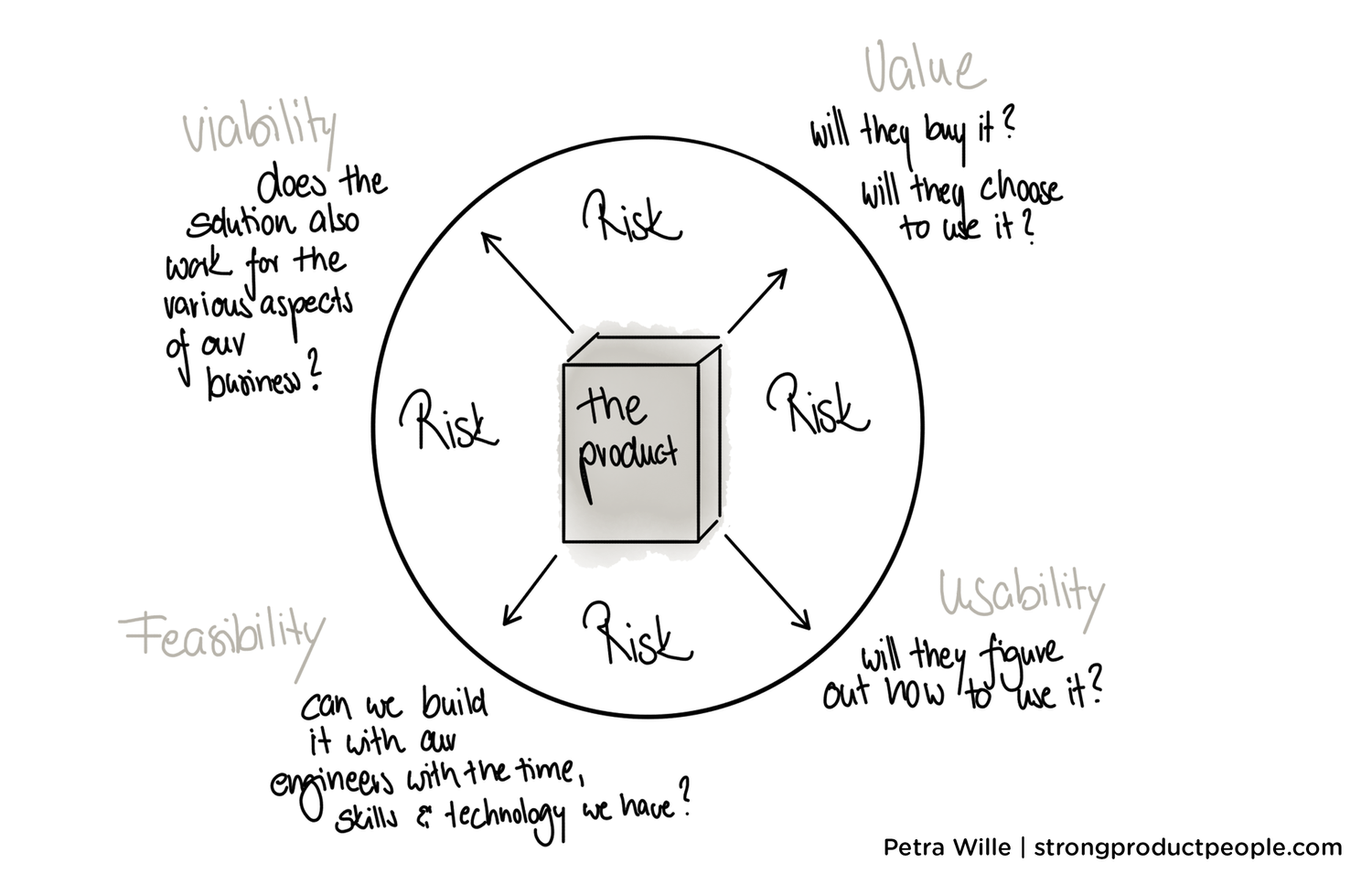
- The four big product risks — desirability, usability, feasibility, viability (Teresa prefers “desirability” where Marty Cagan uses “value” in The Four Big Risks)
- Petra’s experiments slide — her “tapestry” of experiments for de-risking the four risks
- Related episode: “Organizational Change Is Exhausting”
- HIPPO — the “highest paid person’s opinion” problem
- Dunbar’s number — referenced on the company-size threshold where adoption gets harder
- SAFe (Scaled Agile Framework) — mentioned in Petra’s large-organization example
- Continuous Discovery Habits by Teresa Torres — the habits under discussion
Show transcript
00:00:03: Hi folks, this is all
00:00:05: things
00:00:06: product with Petra Wille
00:00:07: and Theresa Corks.
00:00:09: And we're so happy you are here!
00:00:16: Theresa We do have a preparation document for these podcast episodes... ...and All You & I Do before we hit record Is basically look at the two topics that i suggest.. ..and The Two Topics That You Have Suggested Anyone.
00:00:31: Then We Decide on Which We Record.
00:00:34: Today I found something in there was like What, what does she mean?
00:00:38: So it actually says discovery and the four risks.
00:00:42: And that you're not sure if discovery does duty to dephobic risk.
00:00:48: or explain a bit more about your main I'm wondering where the spicy take is on dad one because discovery dephopic risks they work so well together.
00:00:57: i love them in coaching.
00:00:59: use the for big risks a lot.
00:01:01: Take us wherever You want To take Us.
00:01:04: Yeah, I'm not questioning the four risks.
00:01:06: I'm questioning Okay
00:01:09: everybody.
00:01:10: your whole audience is like oh my god
00:01:12: i wrote a blog post that im afraid to publish.
00:01:16: We'll start there.
00:01:18: So maybe we can discuss it a little bit and then our listeners can tell me whether I should publish or not.
00:01:23: Or, maybe you could tell if i should publish?
00:01:25: Yeah the thing is that You will NOT actually sit with It for that long!
00:01:29: I think He'll hit Publish right before but let's see... We'll
00:01:33: See!
00:01:33: Double
00:01:34: click on The Topic!
00:01:36: Okay so the blog post Is titled Does Continuous Discovery Have Product Market Fit
00:01:45: For
00:01:45: Whom?!
00:01:47: Well who's the customer?
00:01:51: Discovery?
00:01:52: Yeah, like if I say the
00:01:54: organization
00:01:56: that wants
00:01:57: to earn money with and therefore de-risked stuff they're building.
00:02:03: Yes okay so If i think about The discovery habits as a product And my customer is the organizations that hire us for turning
00:02:12: Yep!
00:02:12: If Im good Product Manager I need to evaluate their risks in My product.
00:02:18: yeah Okay So I've been doing this For fifteen years.
00:02:22: When I teach a product manager how to evaluate risk, we look at desirability risks.
00:02:29: I know Marty uses value but i prefer design ability.
00:02:36: By the way The way that I teach the four risks is have them story map.
00:02:40: what does customer has do?
00:02:41: get value from solution and then step by step for desirabilty?
00:02:48: Do they want take those steps And are they willing to log
00:02:52: in?
00:02:53: Is our famous example for that.
00:02:55: Yeah, do they desperately want to login?
00:02:59: yeah so maybe one two and Are They Willing To?
00:03:02: and sometimes those aren't.
00:03:04: Those Aren't the same right.
00:03:06: and then usability are they able too?
00:03:09: Can they find it?
00:03:10: Do they understand It?
00:03:11: or The Able Too Right.
00:03:13: and Then Feasibility is more like.
00:03:14: is it technically possible build
00:03:16: with the people?
00:03:17: viability
00:03:18: is Will it be good for the business?
00:03:20: Okay, if I think about the discovery habits and not just my discovery habits like all of Discovery.
00:03:26: If i think About It as a product And I Think About The Customer As Organizations That Want To Get Better at Building Product Then I Think From Those Four Risks.
00:03:35: If Im Being A Hundred Percent Honest I Don't Think There Is A Lot Of Risk.
00:03:41: Here's Why
00:03:43: Wait Wait Wait.
00:03:44: Your claim is theory, hypothesis that from the perspective of the organization a discovery is expensive.
00:03:54: The experiments are expensive and the de-risking is not doing enough good for the organization to have product market fit?
00:04:05: Is there what you're saying?
00:04:07: No!
00:04:08: I will start by saying...
00:04:10: Yeah i'll start my saying..I wholeheartedly still believe in continuous discovery.
00:04:15: That is not a
00:04:16: question.
00:04:16: Yeah,
00:04:19: I
00:04:19: think
00:04:20: companies Think they want to adopt good discovery practices.
00:04:26: So they'd want it right?
00:04:27: Mm-hmm They're willing to pay for it Right.
00:04:31: so there's viability.
00:04:32: i don't see viability risk.
00:04:34: i have plenty of companies reaching out every week asking For help with discovery.
00:04:38: i think the challenge Is if we look at like each habit as A solution Each of those habits have their challenges of willingness.
00:04:49: so Okay, I might want to talk to my customer every week But am i willing?
00:04:55: To reserve the time on My calendar.
00:04:57: Am I willing to do it in The weeks when things get busy and I'm willing to overcome the obstacles In the way When I don't Have access to customers?
00:05:06: or my organization won't.
00:05:07: let me bet
00:05:08: but you have thought It through that my argument here would be that you beautifully addressing this with this habits aspect of your work.
00:05:17: Because the thing is, and it's at least what I see...I do have one slide.
00:05:23: maybe i take a screenshot.
00:05:24: we put in show note?
00:05:27: And its old but lists a ton of experiments to de-risk the four risks just not sorted by any risk or something like tapestry of different experiments that one could run.
00:05:43: And in my experience, it's always like you have to expose people to several ones of them.
00:05:48: You cannot expose them to all of.
00:05:50: then Then you can get them To try some Of them.
00:05:53: they fall in love with Some of them and then They're willing to do those Because they saw the benefit of Them and they become a habit at some point.
00:06:02: Yeah this has a personal tendency of People product.
00:06:06: people coming from The design background, tend to do more usability de-risking.
00:06:11: Product people coming from a business standpoint doing more of a business case modeling the risking viability standpoint.
00:06:21: but I think your idea and you're teaching off it has to become habit.
00:06:25: And we have try several things.
00:06:27: then see what becomes the habit is actually point right?
00:06:32: It's still patchy!
00:06:34: People could be.
00:06:39: How do you call it more precise on that?
00:06:42: Did the risk all four equally?
00:06:44: well, I'd say somehow.
00:06:47: I think your misunderstanding what my argument.
00:06:50: so...I'm not arguing.
00:06:52: The Four Risks don't have...
00:06:55: Yeah!
00:06:55: No i get it but you
00:06:58: argued
00:06:58: then If and
00:07:00: if- And im not..i dont even think the problem is at team level.
00:07:03: I know plenty of product teams That are trying to adopt habits & having a lot success with them.
00:07:09: If my customer is a company, and my solution is continuous discovery.
00:07:19: In order for that solution to be effective in the organization... The organization has to be willing To change things to allow their teams to adopt those habits.
00:07:40: And what I see over and over again, there's something about the organizational context.
00:07:46: This is why we recorded an episode called Organizational Changes Exhausting.
00:07:52: There are some things that make it extremely challenging for continuous discovery to work effectively in the organization.
00:08:09: And so, yeah.
00:08:09: But isn't it?
00:08:11: on one hand because there is no such thing as the organization?
00:08:16: Because that's a hypothetical construct anyways There are just like people
00:08:23: Yeah and but... No!
00:08:26: There IS A Thing Called The Organization And the organization has structures That I think Are Hard To Change For Better Omers And Make It So.
00:08:37: This Is Not Good Fit Like what are some of those things?
00:08:41: I think we and this is gonna sound like blame.
00:08:44: I'm not blaming And that's where this is, like a really delicate topic in why i'm afraid to write a blog post about This.
00:08:49: if i look at here We go.
00:08:50: If i look
00:08:51: it
00:08:51: up if i looked at an organization At the top we have a board that governs for organization.
00:08:57: The Board if they're public even if They're not Public still Is looking at quarterly results.
00:09:02: They want To see uh charts That Go Up into the right.
00:09:07: They Want There to be continuous improvement and not this like bumpy jagged improvement.
00:09:13: So starting at the very top, there's this expectation that things be predictable in certain.
00:09:18: Then we get to the executives that run the company And the executives.
00:09:21: almost all of them have experience in their industry Have experienced in their role function?
00:09:27: They have a very strong belief That what got them here will get them there.
00:09:33: An incentives
00:09:34: program from the board
00:09:36: that reinforces those things, right?
00:09:39: And so it's really easy for an executive and I'm not even saying this is wrong.
00:09:45: It's not a criticism, it's not blame.
00:09:46: Its' really easy to feel one hundred percent certain about their proposed solution.
00:09:55: This why we have the HIPPO acronym Right.
00:09:58: For decades We've had executives walk into product team rooms say build these exact solutions.
00:10:05: I have an idea.
00:10:07: We've lots of evidence that most things we build fall short.
00:10:11: our expectations, despite all the evidence were not seeing a change in this behavior.
00:10:17: We come in collectively to consult people who believe in continuous discovery and say they're going teach you better way but what happens is learn them better ways start doing it run into.
00:10:30: these systemic obstacles I'm starting to believe are impossible to change.
00:10:39: Because, I talk a lot of consultants and don't know the only time that i've ever seen this last at an organization is when a leader like CEO or product leader with a lot influence on the CEO stays in company for very long-time.
00:10:59: We're
00:11:01: like companies that are below Dumbouts number inside.
00:11:07: Companies
00:11:08: at what?
00:11:08: That is small, so below one hundred twenty employees
00:11:11: Yes!
00:11:12: Okay.
00:11:12: So
00:11:14: everything I'm arguing we're gonna say it's true for an organization larger than N employees and i don't know how to define n but i agree with you this can work in small organizations really well yeah But as the organization grows It becomes more and more impossible.
00:11:33: Yes.
00:11:35: First harder than impossible.
00:11:37: Yeah,
00:11:38: I'm
00:11:39: not convinced it's possible and that's like a very alarming thing to me right?
00:11:43: And so i can get frustrated by the organizational systems which we all do.
00:11:49: Right.
00:11:49: We've been at conferences speaking to every speaker and consultant in this space who is frustrated that you know leaders hire training for their teams but they don't hire training themselves They don't overcome, they don't deal with the organizational barriers.
00:12:03: Like this is something literally every consultant in the industry gripes about but maybe that's the wrong way to look at it?
00:12:10: Maybe the problem is not the organization.
00:12:12: we should hold those constraints as required like The organizational incentives and governance and structure Is not going to change And maybe our solution is wrong.
00:12:22: I don't mean That i've lost faith In discovery.
00:12:26: We need another Way to bring customer centricity and feedback loops into organizations in a way that fit better within these organizational constraints.
00:12:39: Is there any book coming up, Theresa?
00:12:44: No I don't have an answer yet!
00:12:46: i just see a glaring problem.
00:12:51: Yeah so the blog post you're reluctant to write is...and I bet you already half written it because that's how we think.
00:13:02: Is it more about the observation or are you hinting at potential routes for de-risking your hypothesis?
00:13:12: The ways to finding your answer.
00:13:15: I think if we keep going into organizations and saying, You need a push decision making to your product teams We're gonna be limited in the impact that we can have.
00:13:30: Fundamentally It's like...we had this belief that product teams are closest to the customer, they should be empowered.
00:13:40: And I believe that still wholeheartedly like i do...I'm not questioning that!
00:13:43: I'm not-i'm not questioning the value of that.. I'm questioning whether thats feasible in a modern organization of a certain size.
00:13:54: and I think we have lots evidence at least I do through my training practice where companies try it ,and they try it .And They Try It !And They Try It !
00:14:02: And It Doesn't Stick.
00:14:04: And if it was just me, If I was the only one facing this.
00:14:06: I would just conclude i'm not very good at this but It's Not Just Me!
00:14:10: I talked to every other consultant in The Space and we all face the same problem.
00:14:15: It true But I still find a lot of motivation and reward In...I don't know even if let's speak organizations that have fifty product teams and twenty-five Of them running safe because who ever decided that is an ideal scenario for delivering software.
00:14:38: That's what they do, so there are a few left and we work with those and we have pilots.
00:14:44: and they really adopt these continuous discovery higher habits and it really see the benefit of them themselves.
00:14:53: because to me once you worked in this way what has been seen cannot be unseen.
00:14:58: basically To me, it's very rewarding if even like I don't know ten percent of the teams themselves because The people in the team suffer less.
00:15:08: The teams see their work having more impact and finally be successful Because there is nothing more demotivating than numbers that are not moving In product right?
00:15:21: And then you adopt some of the discovery habits Finally deliver stuff That makes an impact.
00:15:25: You can see the number changing at least for that team.
00:15:30: And yeah, we target the organization but isn't it good enough of a result if ten percent of the organizations products improve?
00:15:42: I'm not sure!
00:15:44: Okay i don't question the impact...I know hundreds of people..i hear from them every day about the impact on my book ,the impact on their individual habits .The impact on That's all at the individual team level.
00:15:59: I'm just questioning this, at the organizational level and i think where we... Where there is not a willingness or the desirability risk?
00:16:09: Is that.. There are three components of this in way.
00:16:15: to say it sounds terrible but like this is really what were asking We're saying look In order be successful your teams need learn new ways working.
00:16:27: It's hard.
00:16:28: We know organizational change is hard.
00:16:30: it's gonna take a long time.
00:16:31: your organization Is only going to change at the rate of the individuals in your?
00:16:35: Organization.
00:16:36: they're all Gonna change at The same different rates which means throughout the Change you're gonna have A lot of chaos because you can Have people working on old way, we don't even work in them new way.
00:16:45: You got people working in between and by the Way, it's not just your teams.
00:16:49: Your leaders have to learn To not dictate solutions Which is really hard for them Because there held accountable two outcomes And they need to hit those outcomes, be successful.
00:17:00: The way that you feel confident is by dictating solutions.
00:17:04: but when we do that break trust with their teams which means the team no longer want a good discovery.
00:17:10: so we have this vicious cycle of breaking trust destroying habits not getting results.
00:17:16: With
00:17:16: each other.
00:17:17: yeah
00:17:17: and btw your still being asked as leader deliver quarterly result during all these?
00:17:24: change like That seems like an impossible ask of organizations.
00:17:30: And I don't have any answer to this question, but what i'm starting To ask is there a way?
00:17:36: To help organizations adopt the discovery habits in A Way that works within the incentive system?
00:17:44: Within these constraints if we have to deliver quarterly results We Have to Our executives are going to feel right and want to dictate solutions.
00:17:56: How do we help in that situation?
00:17:59: What I'm questioning is how does our solution collectively as an industry, for those of us who advocate for discovery... ...how can we evolve so better fit what you're seeing from the organization time after time?
00:18:13: That's a very advanced thought!
00:18:18: This is where innovation in the field comes from.
00:18:21: I think you should write a blog post, publish it with that particular question and then a workgroup will form... With people who love to think about these tricky questions.
00:18:33: Other thought leaders are invited And let's see what we land.
00:18:39: It'a good question.
00:18:41: Yeah
00:18:43: okay Then lets do this.
00:18:44: So people please Write to Teresa about your take on it, and then maybe it becomes an even bigger plug post I'd say.
00:18:53: Oh this was philosophical!
00:18:55: Thank you Theresa for throwing that at us and me.
00:18:57: Thanks
00:18:59: Petra.
New comment