Trash Can Tracking
Show notes
Key takeaways
- Trash can tracking means placing trash can symbols along your discovery and delivery boards so that discarded work is tracked as deliberately as delivered work.
- It helps answer two questions leaders and teams ask often: "Are we innovating enough?" and "Is our discovery actually working?"
- The "golden trash can" is what happens when a shipped feature flops and the team removes the code — - Petra and Teresa debate whether that belongs on the delivery board (as wasted effort to avoid) or the discovery board (as learning to celebrate).
- An empty solution-discovery trash can is a clear red flag: it means the team isn't comparing and contrasting multiple options.
- An empty problem-space trash can is more nuanced — it could signal an innovation gap, a command-and-control culture, or, if your strategy and vision are strong, a perfectly healthy filter working as intended.
- Whether customer problems even reach the board depends on psychological safety — can support agents, salespeople, engineers, and customers all bubble problems up to be assessed?
- The trash can also becomes a ritual for retiring "zombie opportunities" — decisions a team made to walk away from a problem that the rest of the org keeps resurfacing.
Also discussed
- Why saying no to certain customer problems is a sign your strategy is actually working.
- A brief detour into German recycling supremacy.
- A teased future episode: "Unpacking Innovation."
Resources & Links:
- Follow Teresa Torres: https://ProductTalk.org
- Follow Petra Wille: https://Petra-Wille.com
Mentioned in this episode:
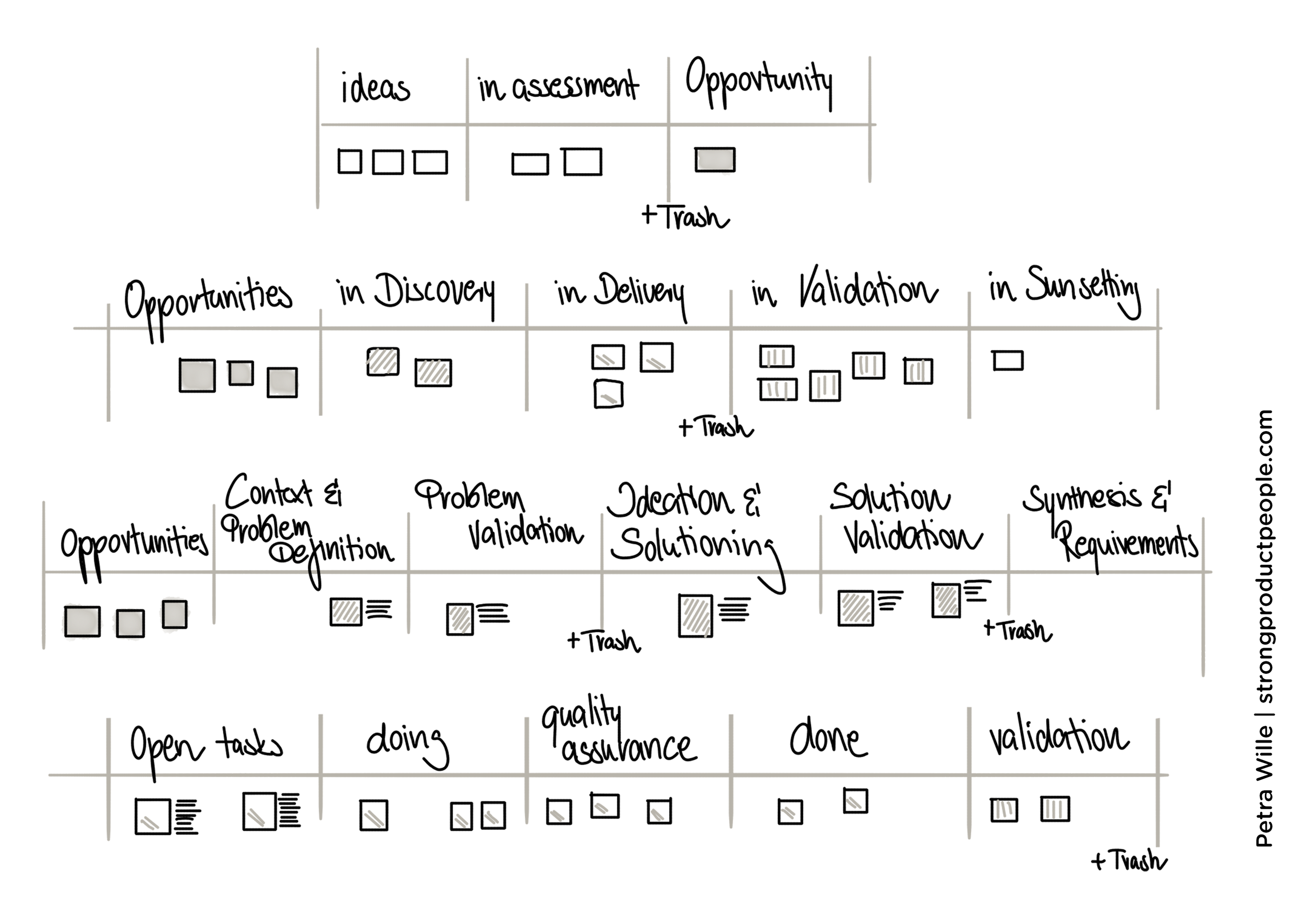
- Illustrations of the discovery and delivery task boards
- Petra’s blog post explaining the idea assessment: Opportunity Assessment: Do We Want to Invest in Discovering This Idea?
- Opportunity Solution Trees (OSTs) — Teresa's continuous discovery framework
- How Compare and Contrast Decisions Lead to Better Product Outcomes
Show transcript
00:00:03: Hi folks, this is all
00:00:05: things
00:00:06: product with Petra Villa
00:00:07: and Theresa course.
00:00:09: And we're so happy
00:00:10: you here.
00:00:17: Petra.
00:00:18: I heard that You have this tactic called trash can tracking.
00:00:24: It makes me think of Oscar the Grouch from Sesame Street?
00:00:28: I don't know why but it does Trash can tracking.
00:00:33: Are you like keeping track of what your recycling and not?
00:00:37: Oh, yeah Germans are very good at recycling.
00:00:40: everybody knows that every
00:00:41: time I go to Europe I go wow us Americans were jerks because we're Not Very Good At This Germany One
00:00:48: Recycling.
00:00:49: The whole world Knows We're Already Jerks.
00:00:51: So Shocking.
00:00:54: But i have a feeling it's not about recycling.
00:00:57: tell me
00:00:59: with the trash cans.
00:01:01: We got punchy, it's going to be a fun episode!
00:01:03: What is the story...
00:01:08: With trash can tracking?
00:01:09: Yeah so at first maybe lead with problem of what trashcan tracking is solving.
00:01:14: often times I get asked either by leadership people executives or teams how do we know if we innovate enough?
00:01:23: interesting question slightly different question, but able to be answered with the same trashcan tracking technique.
00:01:32: Do we know if our discovery is actually a real discovery?
00:01:36: So both interesting questions
00:01:39: now... Before you continue can I push on the first question for a second?
00:01:42: so we
00:01:43: have a little philosophical aside?
00:01:46: Yeah, ex-course!
00:01:48: Should
00:01:48: our goal be innovation?
00:01:54: Maybe that should be a whole separate episode.
00:01:55: We don't have to go on the side of this.
00:01:57: Yeah,
00:01:57: the thing is I think that strongly.
00:01:59: That depends on the company's vision and the company strategy.
00:02:02: in some market and industries There is a lot of pressure around innovation.
00:02:06: then off course.
00:02:08: Partial goal of your discovery should be being innovative And inventing things that maybe the competition has not yet invented.
00:02:15: But you are right for many many companies It's more hygiene factors that are avoiding their success with the customer than it is the massive innovations.
00:02:27: That was my short answer.
00:02:29: Yeah, and already like there're so many things I want to push back
00:02:32: on Like you know
00:02:34: what we're gonna put a pin in this And i think We're going to record an episode called unpacking innovation.
00:02:41: Okay Let's go back for that one okay?
00:02:43: You
00:02:43: identified two questions that you get often Are they being innovative enough And does our discovery work?
00:02:50: Yeah.
00:02:51: Now we will put a picture of the task words that I'll be talking about in show notes, but for now people listening to this need to picture agile tasks as we know them.
00:03:04: they have columns and some of those columns i love to attach a trash can symbol which usually is most times just simple because virtual boards everywhere these days, and none of these companies has yet taken my ass to put trash cans in their software.
00:03:26: So it's more virtual thing that we do.
00:03:29: but if the golden trash can is at end of delivery board so... We go through all the motions We put it in front of our users and then we realize, okay nobody's using the feature or they hate to feature.
00:03:51: Or they're not adopting the future or a feature is not working.
00:03:54: anyway was hoping that features should be working on its not solving their customer problem.
00:03:59: And what most likely has been done is first of all acknowledging number one and getting rid off code again right?
00:04:09: Because that is what actually would make the difference.
00:04:12: So we realized it was not as successful, as we were hoping for and we would remove the code.
00:04:16: And that is to golden trash can because we went through discovery motions than most likely there was no real discovery because otherwise you wouldn't have figured out earlier.
00:04:25: this is a bonkers idea.
00:04:27: then We built entire thing with QA did It Was on our board forever!
00:04:35: then we realize it's not working.
00:04:36: So that's the golden trash can, We want to avoid stuff moving into that trashcan at any cost and how do we do this?
00:04:45: Glad you're asking Teresa!
00:04:49: Better discovery techniques would help us learn earlier what works and doesn't And This is How we Can Avoid Things Ending Up in That Trash Can.
00:04:58: The trash can has nothing To Do with innovation.
00:05:00: I'd say It's purely to see if Discovery Is Working from my perspective.
00:05:06: That's
00:05:06: already a question?
00:05:08: Yeah, I love this idea but i have some issue with your imagery!
00:05:15: I want the golden trash
00:05:16: can on it.
00:05:18: no...I
00:05:18: want the Golden Trash Can On The Discovery Board because we should celebrate when we put something in the Golden trashcan and on the delivery board..i wanna dump truck.
00:05:30: okay
00:05:31: We're tearing down the building Right like a big bomb or like a demolition.
00:05:37: Like bringing the building down.
00:05:39: look at this wasted effort and we should be
00:05:42: already planning to redraw my illustrations.
00:05:45: Yeah,
00:05:47: yeah I love it.
00:05:48: okay that's cool.
00:05:49: Okay.
00:05:49: So let me just cover where we've been.
00:05:51: We have a trash can tracking what?
00:05:53: This means is on our discovery board were tracking?
00:05:57: no.
00:05:57: now after delivery board We talk about the discovery part in a second
00:06:02: on the delivery board.
00:06:03: Yeah.
00:06:04: We're throwing away things that after we released them and measured they had no impact, were taking the time to remove that code and throw it away
00:06:14: which I am fully endorsed!
00:06:17: Yes.
00:06:17: Fully endorsed...I just want to prevent from happening by having better discovery.
00:06:22: Exactly now are talking And Now coming into the Discovery Board.
00:06:26: That could be same board i don't argue for you have two split task words.
00:06:30: i dont care teams but Discovery work should be as visible somewhere, As your delivery workers.
00:06:38: That is what I'm advocating for here.
00:06:40: so wherever you put it and i use two boards very closely located to each other And both owned by the team The trio whatever You call It but its not a leadership board or something like that Its teams working environment.
00:06:57: So we have a discovery Board And in my world, that usually comes with columns like have we understood the problem space well and have we defined initial context well enough so that we can start to look at this solution space a bit more of discovery.
00:07:15: Then we have different experiments where you run each phase for example do need more information?
00:07:22: Do we go broader or are currently already... We've understood problems well enough a particular solution.
00:07:30: All of that needs to be tracked somewhere, we have different columns for that and I like to place trash cans all along the way.
00:07:38: so for example if somebody brings us a problem and says it's a big problem.
00:07:42: then we look into it in figure.
00:07:44: yes on full moon for twenty of our customers is a problem.
00:07:50: Then we can decide to trash because strategically has no relevance solving this very small part of our customer segment.
00:07:59: But maybe it's almost valuable customers, then that's a different story.
00:08:03: but you get the idea right?
00:08:05: So there is a trash can dare.
00:08:06: they will say.
00:08:07: like we looked at the problem not enough people had.
00:08:10: So we no longer looking into the problem, for example or innovation.
00:08:15: We saw a competitor doing something really new and fresh And we wanted to find our own take on it and run a few ideation sessions A bit of brainstorming from the beginning on.
00:08:31: we need to partner with somebody else.
00:08:32: We don't have this partner at hand, it takes us ages to find someone.
00:08:36: so for that time being we decide okay?
00:08:38: This idea is completely derailing us and not longer pursuing it.
00:08:43: So can be super innovative but still put in our trash cans.
00:08:46: That's an early trashcan discovery.
00:08:51: later discovery trash cans where you already have a decent prototype.
00:08:57: You maybe even put it in the re-click dummy, you put users in front of it... ...you had scenario based interview to see if they actually succeed and then you could still learn down the line A your problem.
00:09:11: discovery was not good enough And you learned too late that it's not a thing or be.
00:09:17: the solution is just, Not what people want.
00:09:19: A lot of my clients are seeing this right now with forms as an interface because People turn to learn they can talk to computers and They start To have this like okay but why Can I Just Like Talk The Machine Here?
00:09:34: Why Do i Have To Fill All These Boxes So that, for example would be a later stage discovery finding.
00:09:40: That you say like yeah okay this idea was nice.
00:09:43: the form we designed is solid but still have to put it in trash can because its no longer working.
00:09:49: We need different solutions Because our solution wasn't ideal and then move into the trashcan as well And there are different ratios of both these trash cans.
00:10:04: You could also problem space discovery.
00:10:09: If you're not moving a lot of ideas into that one, then maybe you should look at your innovation and we record another episode on that one.
00:10:17: if um... You are not moving stuff in to this solution-discovery thing Then the team is thinking about options signal or sign either for a really kind of healthy discovery culture because you want to.
00:10:34: You want to design different versions and then you want two trash four of them?
00:10:37: And one is than the winner version, so that there should be more things moving into these trash cans.
00:10:43: We don't want to avoid stuff moving in those ones.
00:10:46: That's what you would maybe call The golden trash can.
00:10:48: so we have learned something.
00:10:50: So we don't pursue this idea or the feature that we designed is not delivering on the KPI, that we were hoping it to drive for something like.
00:11:03: And all these learnings are good but they still might kill ideas.
00:11:08: this deal might kill features and the trash can symbolizes that work that has happened.
00:11:15: so
00:11:15: okay I do.
00:11:16: you'd like This a lot.
00:11:17: It sounds Like You're Making A distinction between if i throw away a customer If Im Not Throwing Away Customer Problems If I solve every customer problem that I encounter, the cost of that is... ...I might not be innovating enough.
00:11:35: Or focused enough.
00:11:37: so your strategy isn't strategizing because then it's saying no to certain customers problems.
00:11:44: maybe a sales team is bringing or even their customers are sometimes suggesting stuff outside of your strategic corridor.
00:11:51: Yeah!
00:11:52: So when you first started describing this why do we need multiple trash cans?
00:11:57: I can see this distinction between you want to track both things that you're throwing away.
00:12:05: We explored these customer problems, we decided not to solve them for these reasons.
00:12:10: and that indicates one thing about your discovery... ...we explore the solutions, we decide not to solved them.
00:12:16: That uncovers something else about your discoveries.
00:12:19: Yes
00:12:19: exactly
00:12:21: Okay.
00:12:21: so i buy in at that level..I'm really curious what each of those things mean.
00:12:26: So like at the solution level, I think you're absolutely right.
00:12:31: Like I hammer on comparing contrast decisions, comparing and contrasting multiple solutions we should be throwing things away constantly At the problem level.
00:12:42: i find this really interesting especially because some teams are being given customer problems to solve by their leadership And it makes me wonder do they have the ability throw that way?
00:12:56: And like our leaders creating that culture where they can say, we're not going to do this because we learned it's not that valuable.
00:13:02: And the trash cans are helping you have that conversation?
00:13:05: Yeah so then there is a little bit of cultural tension
00:13:10: here.
00:13:11: So one thing I think for example if your not trashing customer problems, basically.
00:13:20: Then maybe there is it's another thing that you could look into his psychological safety right?
00:13:26: So are you having an organization that is bubbling up customer problems?
00:13:32: if so every customer care agent able to bubble something out of the product team Every salesperson and engineer Every intern Every board member Every executive Every customer Every client Right?
00:13:47: So you should be able to at least take them all in and then look at them very quickly through this filter or lens of your product vision, product strategy.
00:14:00: Maybe the goals that you currently try to pursue whatever you have handy um... And really do these?
00:14:06: quick assessment is this problem worth solving for us as an organization that talks about how to assess these problems.
00:14:16: You need a bit of structure for data assessment, but that sends conversation to have and if you're not able to move things in the trash can then this is because maybe you don't have enough problems coming in than you can work on that or you don' t have framework for trashing as in assessing them?
00:14:36: Then Is there a framework?
00:14:40: or are they things that we always take into account when looking at the customer problem?
00:14:45: And this takes us down the road of what we always know.
00:14:48: So, have you looked at all four big risks for software development?
00:14:52: Yadda yadda yaa!
00:14:53: There's nothing new here... ...or the cost to not doing it.
00:14:56: so the costs of not solving those customers problems?
00:14:59: What is their opportunity cost there?
00:15:01: It has very normal questions but there should be things moving in the trash can.
00:15:09: Yeah, I definitely agree with that like.
00:15:11: I don't think we should be addressing every customer problem We encounter.
00:15:15: So i definitely agree That they shoot.
00:15:17: there Should Be a trash can for that?
00:15:19: i'm really you got my wheels turning on.
00:15:23: What are the reasons why that might not be happening?
00:15:26: Like if You're Not doing that what is that A symptom of?
00:15:30: and i Think you've Nailed a few Of them.
00:15:32: i think it Can Definitely be a Symptom of like.
00:15:34: Is There Psychological Safety to Push Back could be a question of like, I guess if you... Like the piece that I'm noodling on is.
00:15:51: I think there's this assumption that If your not being innovative enough You're Not finding big Enough customer problems That you couldn't do all Of them?
00:16:03: The threat i am trying to pull On Is like Im trying not To have our innovation episode right now.
00:16:08: But theres This.
00:16:10: There's this idea of like.
00:16:12: if I can complete every customer problem that comes across my plate Am i looking
00:16:17: at big
00:16:18: enough?
00:16:18: Customer problems.
00:16:20: Yes, totally agree.
00:16:21: Yeah um.
00:16:23: and then
00:16:23: I do agree with the premise that like strategy If you have a good strategy in place And if you have clear vision there are definitely customer problems.
00:16:33: You should be saying no to.
00:16:34: That is A Good Indicator that you Have a Strategy In A Vision.
00:16:40: But I'm just wondering if there's a world where, If i do really good discovery and have clear vision.
00:16:47: And I had the clear strategy Am I only putting customer problems on my board that already been through filter?
00:16:55: So am solving every customer problem I encounter?
00:16:58: My trash can is empty.
00:16:59: That not necessarily a symptom.
00:17:01: Somethings wrong.
00:17:02: It actually could be signal Everything right.
00:17:06: Yeah it exactly so its not.
00:17:08: It's not mutually exclusive.
00:17:11: So it can, that is why I love to do this in coaching situations when i know more about the company and organization they set up how good their strategy.
00:17:21: for example because with my experience uh, command and control hierarchy versus empowered teams kind of conversation that we need to have.
00:17:39: So you need a bit of experience or gut feeling Or senior product leader in the organization To be able to help The team understand why this actually is.
00:17:50: so there Is no easy formula That I can hand it as podcast to say like hey And if You see This then It's always A symptom for Dad.
00:18:01: The other trash can, by the way.
00:18:02: So it's easy for a trashcan at the end of the process that we know what the problem actually is and it's easier if the solution discovery trashcans stays empty then the team is not comparing and contrasting or thinking in solutions.
00:18:19: That clear symptom I'd say.
00:18:21: But this early trashcan needs more attention And context to have conversation.
00:18:29: what symptom are we actually seeing here with this trash?
00:18:32: can staying empty or staying super full, or only be used occasionally?
00:18:38: Or all these kind of things.
00:18:40: That's my- Yeah
00:18:41: I like that.
00:18:41: it um...I agree with you that its certainly a signal and then it can encourage the conversation about What is This Signal Means?
00:18:49: Yes
00:18:49: And
00:18:49: i also liked this physical metaphor Of We Are Deliberately Moving This To The Trash Can Because I know for alot teams that use opportunity solution trees, they might make a team decision not to address an opportunity but the rest of the organization may not be aware of that.
00:19:07: They might know what they learned.
00:19:08: it's still being brought up by sales people and so its almost like this ritual if we are making these decisions...
00:19:14: The zombie opportunity!
00:19:17: Yeah exactly This has been really fun.
00:19:21: I liked this concept for how simple is And i like that.
00:19:24: It got us thinking about What does it mean to throw away a customer or problem?
00:19:29: Yeah, and how?
00:19:30: what's the rate?
00:19:31: I wish that should happen.
00:19:32: And what is that signal?
00:19:33: yeah.
00:19:34: We include a drawing in the show notes then It's easier to follow the conversation.
00:19:38: and we have our next topic which is always great.
00:19:41: Amazing thanks Teresa.
00:19:43: Thanks Petra.
New comment